Modeling
A prime advantage of impedance analysis is the availability of the resonance parameters on many harmonics. Typically, the user has 10 parameters at hand for analysis, which are the frequency shifts and the bandwidths at 15, 25, 35, 45, and 55 MHz (assuming a 5 MHz crystal). Firstly and importantly, this increased depth of information allows for a few double checks. Practical experience tells that not all crystals behave equally well. Secondly, the increased information content can be used for viscoelastic modeling. The Johannsmann group has developed a comprehensive modeling package. The software, as well as a tutorial and a set of slides are available online.
While the full modeling requires some experience, a few general rules can be formulated:
- If the fractional frequency shift Δf / f is the same on all harmonics and if, further, the increase in bandwidth, ΔΓ, is small, one has purely inertial loading (most of the times by a "Sauerbrey film"). The viscoelastic properties of the sample do not contribute to the QCM signal.
- For complex samples, the QCM probes the average stress-speed ratio (the "load") at the crystal surface. Whatever the sample is: if the stress-speed ratio can be computed in one way or another, quantitative analysis is in reach.
- For films in air, the viscoelastic analysis provides the viscous compliance J'' (ω). Even the frequency dependence of J'' (ω) is obtained with fair reliability. The details show that the elastic compliance J' (ω) is affected by artifacts originating from the unknown electrode thickness.
- For films in liquids, the viscoelastic analysis provides the elastic compliance J' (ω). In the thin-film limit, J' (ω) is proportional to the ratio of ΔΓ and Δf.
- The strength of particle-sphere contacts can be estimated on the basis of the "point-contact model."
- If nonlinear interactions are present (for instance occurring if the sample undergoes a stick-slip transition), the frequency shift, Δf, and the shift in bandwidth, ΔΓ, are proportional to the in-phase and the out-of-phase component of the force F (t) exerted by the sample onto the crystal.
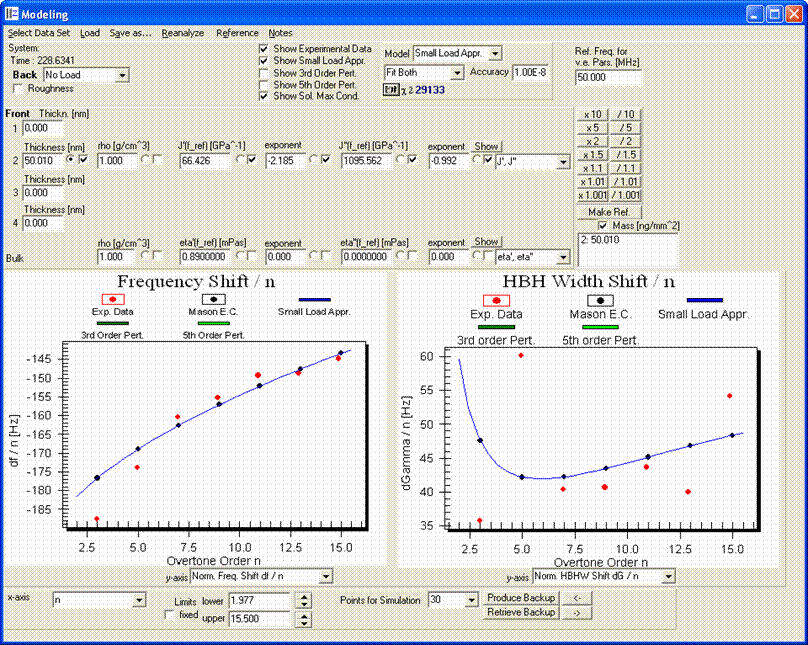
Below is a typical result of modeling.